
Arnold NextG Blogspot: What autonomous driving really means – insight into the system behind the buzzwords
In this first part of our blog series, we take a systemic look at the topic:
Autonomous driving is not a product – it is a networked system
Autonomous mobility is not the result of a single vehicle, but of a distributed system that processes real-time data, makes decisions, and triggers physical movements – safely, transparently, and under all operating conditions. SAE International defines six levels of automation from Level 0 to Level 5 – an international reference framework that has become the standard for developers, regulatory authorities, and industry.
The majority of marketable systems currently operate between Levels 2 and 3. Level 4 is technically possible – but only in clearly defined zones, with defined environmental parameters and a comprehensive redundancy structure. According to the Federal Ministry of Digital and Transport (BMDV), the widespread use of autonomous systems will only be possible with the appropriate infrastructure and comprehensive standards.
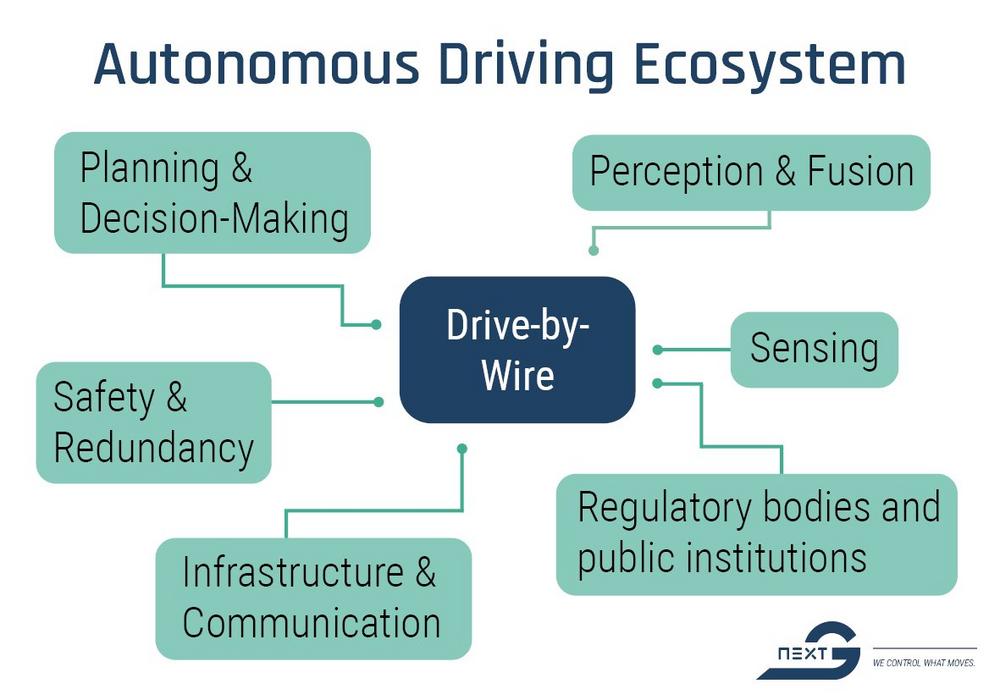
The functional layers of autonomous mobility
Technically, autonomous mobility is based on six layers that are closely interlinked:
This structure is not optional – it is necessary in order to bring autonomous systems into series production. In its 2024 thesis paper, the industry association Bitkom e.V. emphasizes that only through close integration of these levels will true scaling be possible – from pilot projects to widespread operation.
No company can implement autonomy alone
Reality shows that successful autonomous systems are not created in silos, but in ecosystems. OEMs, suppliers, software companies, sensor manufacturers, infrastructure providers, and regulatory authorities are increasingly working in strategic alliances.
One example is Volvo Autonomous Solutions, Volvo Autonomous Solutions provides an example of this by integrating Aurora software into its own vehicles and safety architectures. Redundancy, cybersecurity and safety-by-design are central here – an approach that is setting the tone for the entire industry.
Arnold NextG is also part of such ecosystems – with solutions ranging from autonomous shuttles in public transport to remote-controlled machines in mining, agriculture, and logistics.
The role of drive-by-wire in the ecosystem
Drive-by-wire is considered a basic requirement for Level 4 and Level 5 applications. This is because only fully electronic control of the drive, steering, and brakes allows complete decoupling from humans – whether for autonomous driving or remote control.
Arnold NextG addresses these requirements with a fully integrated security architecture – including isolated communication channels, real-time validation, cybersecurity frameworks, and over-the-air functions.
Beyond Automotive: Autonomous systems in special applications
Autonomy is no longer limited to traditional passenger cars—demand extends far beyond the core automotive business. NX NextMotion is already in use in numerous sectors:
The requirements vary, but the technical basis is the same: a scalable, robust drive-by-wire system.
Conclusion: System thinking determines progress
Autonomous driving is not a vision – it is reality in modular, cooperative systems. Anyone who wants to survive in this environment needs reliable partners, certified systems, and a deep understanding of technological interdependencies. With NX NextMotion, Arnold NextG delivers a platform that meets these requirements – robust, scalable, and ready for real-world use.
In the next parts of this series, we will focus on the individual levels – starting with sensor technology and the question: How do machines actually see their environment?
We control what moves.
Über Arnold NextG:
Arnold NextG realisiert die Safety-by-Wire®-Technologie von morgen: das mehrfach redundante Zentralsteuergerät NX NextMotion ermöglicht eine ausfallsichere und individuelle Implementierung, fahrzeugplattform-unabhängig und weltweit einzigartig. Mit dem System können autonome Fahrzeugkonzepte sicher und nach den neuesten Hard- und Software- sowie Sicherheitsstandards umgesetzt werden, ebenso wie Remote-, Teleoperation- oder Platooning- Lösungen Als unabhängiger Vorausentwickler, Inkubator und Systemlieferant übernimmt Arnold NextG die Planung und Umsetzung – von der Vision bis zur Straßenzulassung. Mit der Straßenzulassung von NX NextMotion setzen wir den globalen Drive-by-Wire-Standard. www.arnoldnextg.de
About Arnold NextG:
Arnold NextG realizes the safety-by-wire® technology of tomorrow: The multi-redundant central control unit NX NextMotion enables a fail-safe and individual implementation, independent of the vehicle platform and unique worldwide. The system can be used to safely implement autonomous vehicle concepts in accordance with the latest hardware, software and safety standards, as well as remote control, teleoperation or platooning solutions. As an independent pre-developer, incubator and system supplier, Arnold NextG takes care of planning and implementation – from vision to road approval. With the road approval of NX NextMotion, we are setting the global drive-by-wire standard. www.arnoldnextg.com
Arnold NextG GmbH
Breite 3
72539 Pfronstetten-Aichelau
Telefon: +49 171 5340377
http://www.arnoldnextg.de
