orcharhino 7.9 Adds New Centralized Host Management and Enhanced Content Management Features

Breaking News:
Sonntag, Aug. 23, 2026
In addition to the new user interface, orcharhino 7.9 expands content management capabilities by supporting multiple content views per host, improves the management of current Ubuntu platforms, and simplifies the integration of audit data into external compliance and SIEM solutions. Furthermore, the new Ansible Director plugin marks another step toward integrated, lifecycle-driven automation.
For more information on orcharhino, visit: https://www.orcharhino.com
Unified Host Management
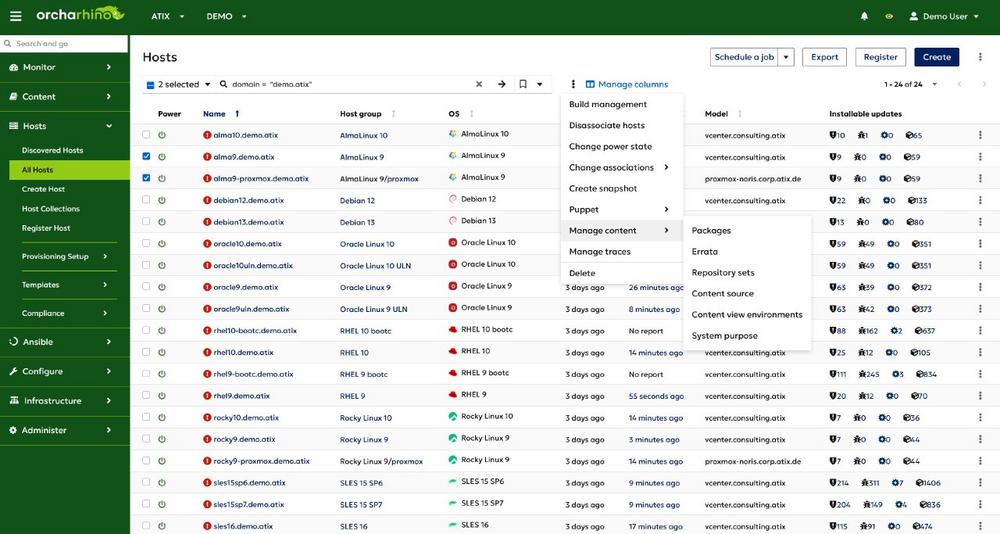
With orcharhino 7.9, the previous “All Hosts” and “Content Hosts” views are consolidated into a single management interface.
Instead of having to switch between different views, administrators now have a centralized overview of their systems and can perform both classic host management tasks and contentrelated actions in one place.
The bulk actions from the original pages have been consolidated on the unified page and are directly available there. At the same time, the interface has been modernized to simplify navigation and make frequently used functions more quickly accessible.
For environments with many managed systems, a Compact Mode is also available, which enables a particularly information-dense display.
Multiple content views per host
Support for multiple content views per host was already introduced in earlier versions as a Technology Preview, but until now it could only be configured via the API or the Hammer CLI.
With orcharhino 7.9, this feature can now be used directly via the graphical user interface. Activation keys and host assignments can contain multiple content views once the feature has been enabled in the system settings.
This opens up new possibilities for release and patch management. For example, organizations can combine versioned content with selected repositories from rolling content views, thereby combining stable release processes with up-to-date packages.
This feature is supported by current clients for Enterprise Linux 8 and later, SLES 15 SP4 and later, Ubuntu 20.04 and later, and Debian 12 and later.
Support for Ubuntu Architecture Variants
With orcharhino 7.9, so-called architecture variants for Ubuntu are supported for the first time.
This allows, for example, the use of the new amd64v3 packages from Ubuntu 26.04, which have been specifically optimized for modern processors. If no optimized variant is available for a package, the system automatically falls back to the standard packages.
The desired architecture variant can be enabled both during provisioning and later via remote execution jobs. For companies with up-to-date hardware, this opens up additional opportunities to optimize the performance of their Ubuntu systems.
Structured Audit Logs for Compliance and SIEM
Orcharhino 7.9 facilitates the further processing of audit data by external systems.
Audit events can now be stored in a separate JSON-based audit log. While regular log messages remain in the production log file, audit data can be specifically offloaded to a separate file.
The structured JSON format makes it easier to transfer information to:
● SIEM systems,
● centralized log management solutions,
● compliance tools
and analyzed there automatically.
This simplifies compliance reporting and improves the traceability of administrative changes.
Tech Preview: Ansible Director
With orcharhino 7.9, the new Ansible Director is being introduced as a Technology Preview.
The plugin extends the management and execution of Ansible content within orcharhino and supports both Ansible roles and collections.
Ansible content can be imported directly from:
● Git repositories
● Ansible Galaxy
and then managed via lifecycle environments.
A key component of this concept is what are known as execution environments. These allow for the use of different Ansible and Python versions regardless of the underlying operating system, thereby creating reproducible and isolated runtime environments.
Furthermore, the organizational separation of content and execution environments ensures that different organizations within the same orcharhino instance can work independently of one another.
Ansible Director thus provides a central platform for the management, versioning, and controlled distribution of Ansible configurations across development, test, and production environments.
About orcharhino
orcharhino is the comprehensive solution for the automation and orchestration of IT infrastructures. The enterprise open source solution can be used in Windows and Linux environments and enables automated deployment, configuration and lifecycle management, as well as release and patch management. orcharhino can be operated on-premises as well as in the cloud.
Developed by ATIX AG as an open source product for enterprises, orcharhino offers organizations of all sizes maximum flexibility, efficiency, and control—supported by a strong partner network and professional support.
For more information, visit www.orcharhino.com.
ATIX AG is a leading provider of solutions for enterprise IT infrastructures and enables efficient, scalable, and flexible system management. ATIX AG operates an ISO 9001:2015- certified quality management system for the development, support, consulting, and training of software solutions, as well as an ISO/IEC 27001-certified information security management system.
ATIX AG
Parkring 15
85748 Garching bei München
Telefon: +49 89 4523538-0
Telefax: +49 (89) 4523538-290
http://www.atix.de/
