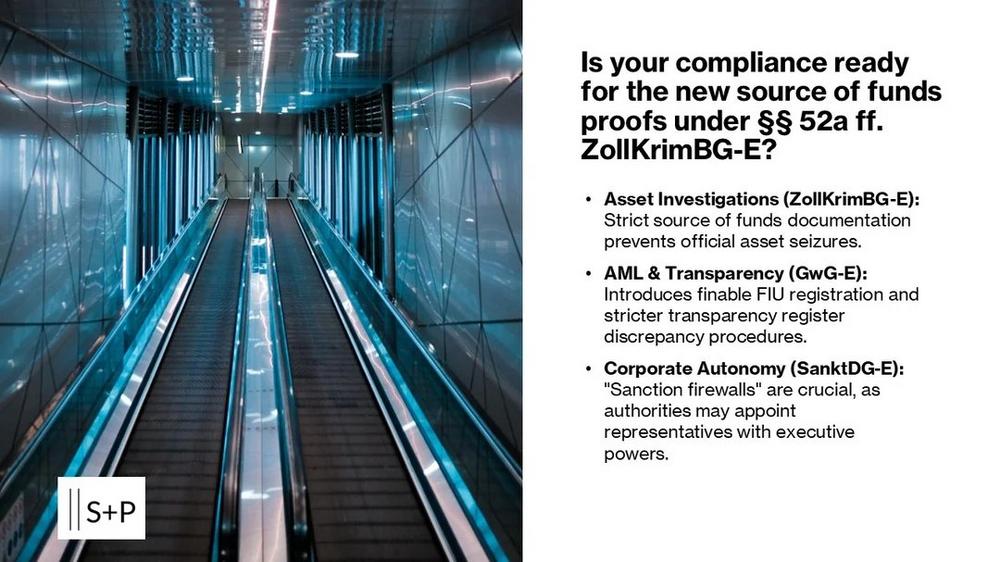
Is Your Compliance Department Ready for the New Certificates of Origin under Sections 52a et seq. ZollKrimBG-E?

Breaking News:
Datacolor erweitert SpyderCheckr-Familie um neue Referenzkarten und Ersatzkarten-Sets
Nachwuchskräfte entscheiden sich für berufliche Laufbahn bei der WEMAG Netz GmbH
Gold-Schock bei 4.200 Dollar: Kippt die Rallye – oder startet jetzt der Sachwert-Boom?
MH Group erweitert ihr „Schietwetter“-Portfolio durch Unternehmenskauf von Schecker strategisch
Donnerstag, Sep. 3, 2026
I. Why this article is relevant
The draft bill from the Federal Ministry of Finance for a law to strengthen customs administration and combat financial crime contains far-reaching amendments to the Customs Crime Prevention Act, the Money Laundering Act, and other specialized laws. Subject to the further legislative process and the final text of the legislation, this could result in significant adjustments for companies in the areas of money laundering prevention, transparency register compliance, enforcement of sanctions, and documentation. The proposed expanded powers of investigation, disclosure, and seizure are particularly relevant for management and compliance and money laundering officers. The planned procedure for suspicious assets pursuant to Sections 52a et seq. of the draft Customs Crime Prevention Act (ZollKrimBG-E) increases the importance of verifiable proof of ownership, financing, and the origin of funds. Personal liability issues are separate from this; they depend on breach of duty, fault, damage, and causation in each individual case.
Procedures concerning suspicious assets: Sections 52a et seq. of the Draft Customs Crime Act (ZollKrimBG-E) provide for administrative proceedings for the investigation, securing, and potential confiscation of significant assets of unclear origin. According to Section 52b Paragraph 3 of the Draft Customs Crime Act, an asset is generally considered significant if its value exceeds €100,000 or if it is subject to mandatory registration; unclear origin is determined according to Section 52b Paragraph 4 of the Draft Customs Crime Act. Securing the assets is provided for in Section 52d of the Draft Customs Crime Act, and judicial confiscation proceedings are provided for in Sections 52h–52k of the Draft Customs Crime Act.
II. Legislative status and intended timeframes
Legislative status: The present text is a draft bill prepared by the Federal Ministry of Finance, not a government bill. Therefore, changes are possible during inter-ministerial consultation, consultation with associations, a subsequent cabinet decision, and parliamentary debate. Statements regarding a guaranteed majority in the Bundestag, the position of the Bundesrat, or a specific promulgation date would currently be speculative.
The draft is situated within the context of Germany’s FATF follow-up review in 2028 and the European AML reforms. This gives the project high political relevance, but does not guarantee its content, timing, or whether individual regulations will be enacted unchanged.
Timeframe: The draft contains entry-into-force dates stipulated in Article 27 of the draft Act on the Promotion of …
Entry into force and transitional provisions proposed in the draft
The tight timeframe results in an extremely short preparation window for compliance officers. The following deadlines must be strictly observed for implementation:
III. Obligations for Compliance, C-Level and other stakeholders
The draft bill contains planned obligations to act, cooperate, and tolerate certain actions. Their final scope depends on the final legal text, the respective entry into force, and the specific area of application for the company.
Specifically, the following normative obligations arise from a legal perspective:
1. Obligations in the area of money laundering prevention (AML)
2. Compliance obligations
3. Duties and responsibilities of the C-level (management)
IV. Potential problems in fulfilling the obligations
The implementation of the amended Customs Crime Prevention Act (ZollKrimBG-E) and the Money Laundering Act (GwG-E) poses significant legal and operational implementation risks for companies. From the perspective of anti-money laundering (AML), compliance, and C-level management, the following key problems arise:
1. Money Laundering Prevention (AML Organization)
2. Compliance Management
3. C-Level (organizational autonomy and personal liability)
To protect against upcoming regulatory tightening, proactive adaptation of internal control systems (ICS) is essential. The draft legislation is situated within the context of European and international developments in AML and sanctions. Since content, responsibilities, deadlines, and penalty provisions may still be amended during the legislative process, "no-regret" measures are particularly advisable, as they strengthen existing compliance organizations regardless of the final wording.
The following “no-regret” measures and solutions are strongly recommended from both a legal and operational perspective:
1. Arrangements for the C-level (management)
2. Provisions for compliance management
3. Anti-money laundering (AML) measures
VI. Conclusion
The draft bill for the Customs Finance Justice Act sends a clear signal for stronger powers for the customs administration, more intensive anti-money laundering measures, and higher requirements for transparency register and sanctions compliance. However, the final version, its entry into force, and specific transition periods remain open.
Companies should therefore neither wait indefinitely nor treat unfinalized draft regulations as if they were already established law. Appropriate measures are risk-based "no-regret" approaches: a robust sanctions control system with regard to Section 9 of the draft Sanctions Enforcement Act (SanktDG-E), current ownership and control structures, centrally managed transparency register processes, and readily accessible documentation of the origin of funds and assets for potential requirements under Sections 52a et seq. and Section 52f Paragraph 1 of the draft Customs Crime Act (ZollKrimBG-E).
The aforementioned measures improve the company’s ability to provide information and evidence, reduce organizational and implementation risks, and strengthen the foundation of proper management. They do not preclude regulatory action or personal liability issues under Section 43 of the German Limited Liability Companies Act (GmbHG) or Section 93 of the German Stock Corporation Act (AktG). However, personal liability always requires a case-by-case assessment, particularly regarding breach of duty, fault, damages, and causation.
S+P Editorial Team
VII. List of Sources
Federal Ministry of Finance: Draft bill for a law for greater fairness through the strengthening of the customs administration and the fight against financial crime (Customs Financial Fairness Act – ZFG-E), status as of February 25, 2026, published on March 3, 2026: https://www.bundesfinanzministerium.de/… , accessed on August 27, 2026.
Legal Notice: This article is based on a draft bill. All information regarding standards, areas of application, transitional periods, fines, and entry into force dates must be checked against the most recent official version before publication and against the promulgated law after completion of the legislative process.
S+P Unternehmerforum GmbH mit Sitz in München ist ein führender Anbieter für praxisnahe, rollenbasierte Weiterbildung im deutschsprachigen Raum. Seit der Gründung im Jahr 2004 unterstützt S+P Fach- und Führungskräfte sowie C-Level-Manager:innen aus der Finanzwirtschaft und Industrie dabei, sich gezielt weiterzuentwickeln und regulatorisch sowie strategisch sicher zu handeln.
S+P bietet ein breites Portfolio an Online-Seminaren, E-Learnings, Zertifikatslehrgängen und Executive Education Programmen. Themenschwerpunkte sind unter anderem Compliance, Geldwäscheprävention, Risikomanagement, Projektmanagement, Finance, Leadership und digitale Transformation.
Ein Alleinstellungsmerkmal ist die S+P Tool Box – mit sofort einsetzbaren Arbeitshilfen wie Leitfäden, Checklisten, Gantt-Plänen und Risikochecks. Zusätzlich steht allen Teilnehmer:innen die digitale Lernplattform S+P Lounge zur Verfügung.
Mit dem Zertifikat S+P Certified und dem digitalen Karriere-Badge dokumentieren Absolvent:innen ihre Kompetenz sichtbar – für Arbeitgeber, Kunden und Netzwerke.
Teilnehmer bewerten S+P Seminare auf ProvenExpert mit 4,65 von 5 Sternen. Für jedes gebuchte Seminar pflanzt S+P im Rahmen des ESG-Projekts „Dein Seminar, dein Baum, deine Zukunft“ einen Baum in Deutschland.
Mehr Informationen unter: www.sp-unternehmerforum.de
S&P Unternehmerforum GmbH
Feringastr. 12 A
85774 Unterföhring bei München
Telefon: +49 (89) 45242970100
Telefax: +49 (89) 45242970299
http://www.sp-unternehmerforum.de
