Invasive Egyptian Geese: They Eat Whatever is Available

Dienstag, Okt. 6, 2026
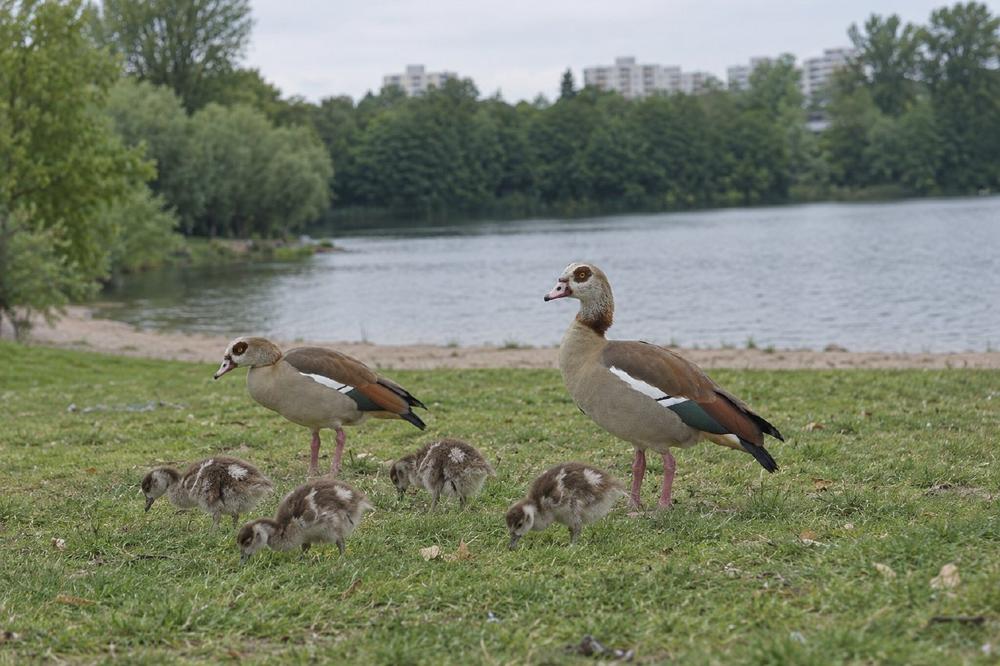
Approximately 11,000 to 15,500 pairs of Egyptian geese (Alopochen aegyptiaca) breed in Germany, according to a nationwide survey conducted from 2017 to 2022. This waterfowl species, originally native to Africa, was introduced to Europe between the 17th and 20th centuries as an ornamental bird in parks. Since 2017, it has been included on the EU list of invasive alien species of Union concern. “Egyptian geese have long since become an integral part of the Hessian landscape as well. Whether in parks, outdoor swimming pools such as Frankfurt’s Brentanobad, or on farmland in the Wetterau region, conflicts can arise wherever large numbers of these invasive birds occur. At the same time, there is a lack of key data required to better assess the impacts of the growing population and develop appropriate management measures. However, both the Federal Nature Conservation Act and EU regulations mandate the protection of native ecosystems from the impacts of invasive species,” explains Prof. Dr. Sven Klimpel of the Senckenberg Biodiversity and Climate Research Center and Goethe University Frankfurt.
To this end, a research team led by the Frankfurt-based parasitologist and infectious disease biologist studied a total of 100 Egyptian geese from the Wetterau region as part of the ZOWIAC (Zoonotic and Wildlife Ecological Impacts of Invasive Carnivores) collaborative project. During the four-year study, the researchers closely examined 25 Egyptian geese each year from the same area near Nieder-Wöllstadt and Dortelweil. The birds were sampled as part of regular hunting operations and subsequently analyzed for their diet and parasite infestation. The study area is characterized by agricultural land, including numerous cornfields, and extends in part along the Nidda River.
“To analyze their diet, we examined the crop contents of the Egyptian geese. Since the food in the crop is still largely undigested, this provides a particularly good way to determine what the birds eat,” explains the study’s lead author, Dr. Anna Viktoria Schantz of Goethe University Frankfurt. The results show that, across all study periods, corn, grains, and grasses made up the bulk of the Egyptian geese’s diet. The study also demonstrates that these geese, which are generally considered herbivores, consume a certain proportion of animal-based food. In addition to plant-based food, the researchers found, for example, earthworms and bivalve remains. “In one year of the study, strawberries were also detected in the Egyptian geese’s crops. Since the strawberries had not yet reached their natural ripeness at the time of sampling, they may have been a food source provided by humans or otherwise accessible,” adds Schantz.
The dietary analysis shows that Egyptian geese make intensive use of anthropogenic resources at certain times. For example, corn accounted for 46 percent of the total crop contents, which made up 58 percent of the total weight of the diet. This was particularly evident during the 2021–2022 study period: Corn was detected in 95 percent of the Egyptian geese examined. “Our results clearly show that Egyptian geese consume the food items that are abundant and readily available—they eat whatever is there,” says Klimpel. “If this occurs only sporadically, it has no major impact and does not necessarily mean that it will result in crop damage, for example, in corn cultivation. However, if huge numbers of Egyptian geese gather and frequent these very areas, this can, under certain circumstances, lead to conflicts with agriculture.” In the species’ native range, negative impacts on crop yields are already well documented.
The research team also focused on examining the Egyptian geese for the presence of ecto- and endoparasites. “Given their sometimes highly specific life cycles and adaptation to certain hosts, parasites can serve as reliable indicators of the host animals’ diet and lifestyle,” explains Schantz. For example, the researchers detected the thorny-headed worm Polymorphus minutus—a parasite that infests the small intestine of waterfowl—in about half of the Egyptian geese examined. This parasite species uses copepods as intermediate hosts for its development. The infected Egyptian geese therefore must have ingested these copepods to become infected with the parasite. In total, the research team identified 17 parasite species in the Egyptian geese studied. Seven of these were confirmed as Egyptian goose parasites for the first time in Europe.
“Our recent study shows that Egyptian geese not only cause conflicts in parks and outdoor swimming pools, but also use agricultural land as a food source, which can pose economic risks. At the same time, these invasive birds carry various parasites that are also a concern for domestic birds and farm poultry. To better understand the impact of the Egyptian goose and its role in the ecosystem, year-round studies would be important. This is because their diet and parasite infestation vary depending on the season, habitat, and climatic conditions,” adds Klimpel, with an eye to the future.
Senckenberg – Leibniz Institution for Biodiversity and Earth System Research // Senckenberg Gesellschaft für Naturforschung
Senckenberganlage 25
60325 Frankfurt
Telefon: +49 (69) 7542-0
Telefax: +49 (69) 746238
http://www.senckenberg.de
