
Even the Digital Government Needs a Plan B
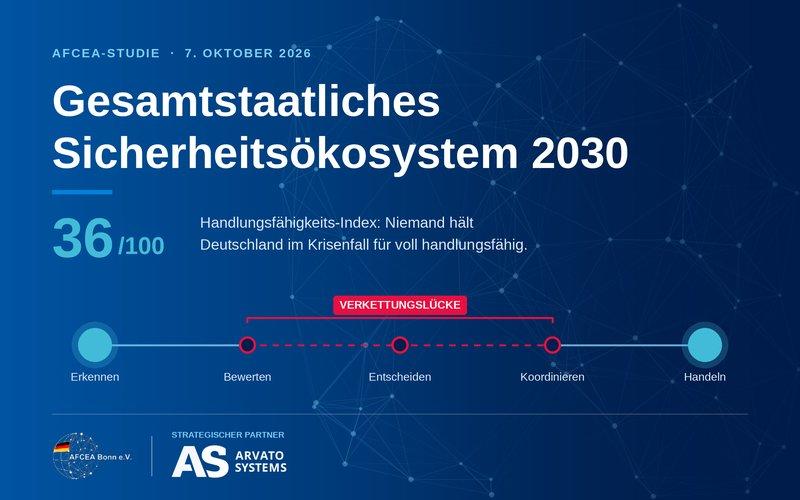
Germany recognizes crises and is capable of taking action. However, the chain of events leading up to and following a crisis is fragile. This is demonstrated by the study “National Security Ecosystem 2030” by the Armed Forces Communications and Electronics Association (AFCEA) Bonn e. V. It will be presented today at the Bonn IT Dialogue. Arvato Systems contributed to the study as a strategic partner with its own analysis. The IT company emphasizes one key finding in particular: Germany is barely prepared for the period following a system failure.
For the study, AFCEA Bonn analyzed 50 interviews and conducted an online survey with 72 participants. A key finding is the so-called “chain gap”: More than 80 percent of the solutions mentioned focus on the two ends of the chain—detecting a situation and taking action on the ground. There are hardly any solutions for what lies in between—namely, assessing, deciding, and coordinating.
The chain also breaks at the end
The study also shows where preparedness ends: Available resources primarily cover the beginning of a crisis, but hardly its end. Most solutions help prepare for or manage a situation. What comes next remains largely unaddressed—even though the recovery phase is the only area where demand exceeds supply. In the crisis cases examined, the recovery phase appears only once: during the power outage in Ludwigshafen, where nothing restarted on its own after power was restored. Preparedness thus ends precisely where administrations and operators must regain their ability to act.
Restart Planning Begins Before the Outage
Arvato Systems derives a clear task from this. The restart process must be known before it is needed. Government agencies and operators must know which processes and data to restore first, in what order, and what they need to do so. “The question is not whether digitization is taking place, but whether digital processes can also survive crises—even using analog means in an emergency,” says Dr. Norbert Ahrend, a consultant for public sector clients at Arvato Systems.
An example from Arvato Systems’ research paper illustrates how far the impact of an outage extends beyond the government agency itself: If a government agency cannot pay invoices for fourteen days, companies face liquidity problems—in the worst case, leading to insolvency. Nevertheless, in many places, budget, cash management, and accounting systems are not as secure as their importance requires. Critical data is stored locally—figuratively speaking, “under the basement stairs”—and is inaccessible in the event of a crisis. “No one can improvise a recovery. Those who know in advance what needs to be up and running first and what’s required to make that happen remain capable of taking action—even if the disruption lasts longer,” says Ahrend.
One Level Deeper: Plan B
Arvato Systems helps public sector clients make their digitalization crisis-proof from the very beginning. To do this, the company analyzes risks and critical processes, establishes a business continuity management system in accordance with ISO 22301, secures critical data with geographic redundancy, and tests the recovery process in crisis simulations. Where digital solutions fail, a physical fallback system takes over. Sister companies within the Bertelsmann Group operate geographically redundant printing lines for this purpose, which can print critical information and deliver it physically. The study describes this approach as follows: “Arvato Systems goes one level deeper.” Arvato Systems advises government agencies first to determine which information is so critical that it must also be available in physical form. Furthermore, it is important for government agencies to ensure their solvency through geographic redundancy—especially in budget, cash management, and accounting systems—and to conduct crisis-scenario drills across different levels and departments.
About the Study
The study “National Security Ecosystem 2030” by AFCEA Bonn e.V. examines how Germany can remain capable of acting in the face of hybrid threats. It is based on 50 analyzed interviews, an online survey, and 172 documented solutions, and identifies 30 measures across six areas of action. Available for download starting October 7, 2026: Home – AFCEA Bonn e.V.. Arvato Systems’ perspective: Digital Transformation by Arvato Systems.
Arvato Systems is an international IT specialist that supports major companies in Digital Transformation. We stand for strong industry knowledge, in-depth technology expertise and a clear focus on customer requirements. Working as a team, we develop innovative IT solutions, transition our clients into the Cloud, integrate digital processes, and take on IT systems operation and support. As part of Bertelsmann, we are built on the solid foundations of a German global corporation. At the same time, we rely on our strong strategic partner network with top international players such as AWS, Google, Microsoft and SAP. We make the digital world easier, more efficient and more secure and our customers more successful. We Empower Digital Leaders. www.arvato-systems.com
Arvato Systems
Reinhard-Mohn-Straße 18
33333 Gütersloh
Telefon: +49 (5241) 80-80888
Telefax: +49 (5241) 80-80666
https://www.arvato-systems.de
