Confident navigator through rough waters

Breaking News:
Mittwoch, Aug. 12, 2026
“Actually, I was a very average student,” reported the son of a French mother and a German father. He was enthusiastic about sports and spent almost every afternoon on the soccer field. At the age of six or seven, he discovered another passion: playing card games introduced him to the fascinating world of automobiles – his path seemed to be predestined.
Unspectacular entry, unstoppable rise
Nevertheless, after graduating from high school, he initially pursued a career in journalism. It is thanks to his former supervisor at the Süddeutsche Zeitung that he ended up going in a completely different direction. “You write quite well, but you should consider studying,” he advised the young Nicolas Peter.
So Peter gave up his journalistic dreams and began studying law, which he really enjoyed and in which he performed much better than at school. His move to BMW was rather unspectacular: he spent his elective internship during his legal training in the group’s finance and tax department. When a position became available there at exactly the right time, he just stayed.
This marked the beginning of his unstoppable rise within the company: he held his first management position in the treasury department in Belgium, which is responsible for finance and liquidity. It quickly became apparent that “I always found it easy to lead. Perhaps it helped that I was the oldest of four children.” Yet he was only at the very beginning of his career: over the years, the Mannheim native would take on a wide variety of management tasks. He headed the Europe business region, was responsible for group controlling, and was eventually appointed to the board as CFO.
Remaining flexible and dynamic
On his long journey to the top, he repeatedly navigated the company through rough waters: he felt the consequences of a poorly executed takeover, had to cut costs, and prevent the business from going down during the euro crisis. But that is precisely what helped him grow and learn: “You need a long-term plan, but at the same time you have to accept that something will always happen to disrupt your plans.”
What remains is a look into the future, and at BMW, that future is electric: The group has been investing consistently in this area for years – initially by electrifying existing vehicle models, and since 2021/22 through a dedicated development platform for electric vehicles. At the same time, the manager warned against focusing exclusively on electric cars: “Our big task is decarbonization and lower emissions, but there is no single answer to this task.” Hydrogen vehicles, for example, could reduce the current dependence on Asian battery cells, and petrol cars will still be around in 20 years‘ time.
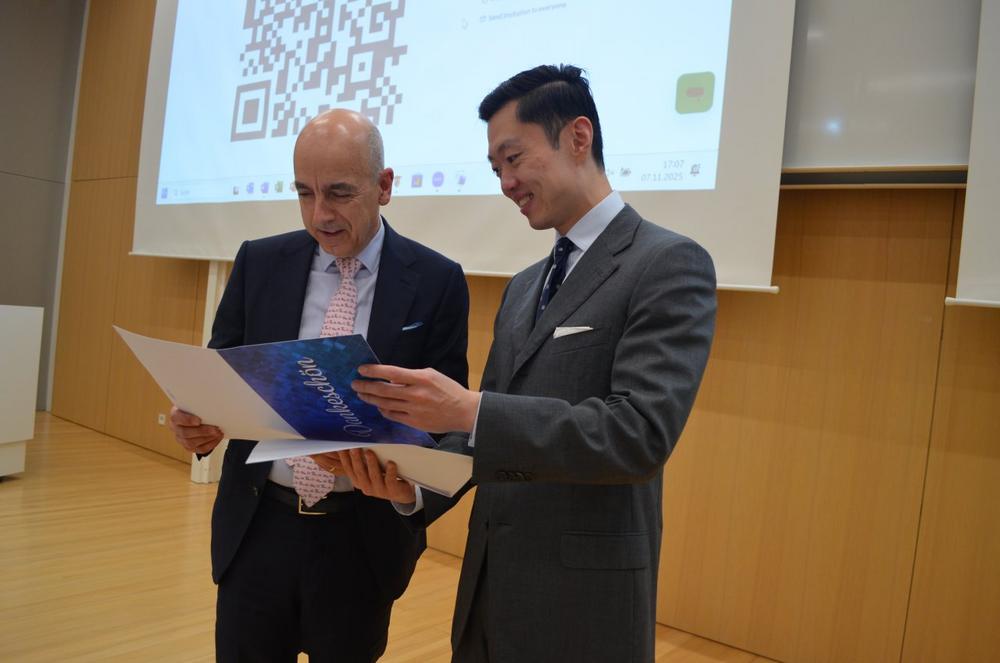
In the subsequent discussion with students from TUM Campus Heilbronn and other institutions at the Bildungscampus Heilbronn, Peter revealed what makes BMW so successful: like a good sports team, the company never rests on its laurels. “Difficulties motivate us. Sometimes we almost construct them in order to keep the momentum going,” said Peter. But it is not only the way it deals with crises that sets the Munich carmaker apart, but also the philosophy behind its products: “We have never developed the vehicles with the most horsepower. Instead, we have always developed very dynamic and lightweight cars that guarantee maximum driving pleasure.”
Die TUM Campus Heilbronn gGmbH
Bildungscampus 2
74076 Heilbronn
Telefon: +49 (0) 7131 264180
Telefax: +49 (7131) 645636-27
https://www.chn.tum.de/de
