Arnold NextG Blogspot: The Driver Shortage Is a Stress Test for Public Transportation

Dienstag, Juli 7, 2026
Driver Shortages Are Changing the Operational Architecture of Public Transit
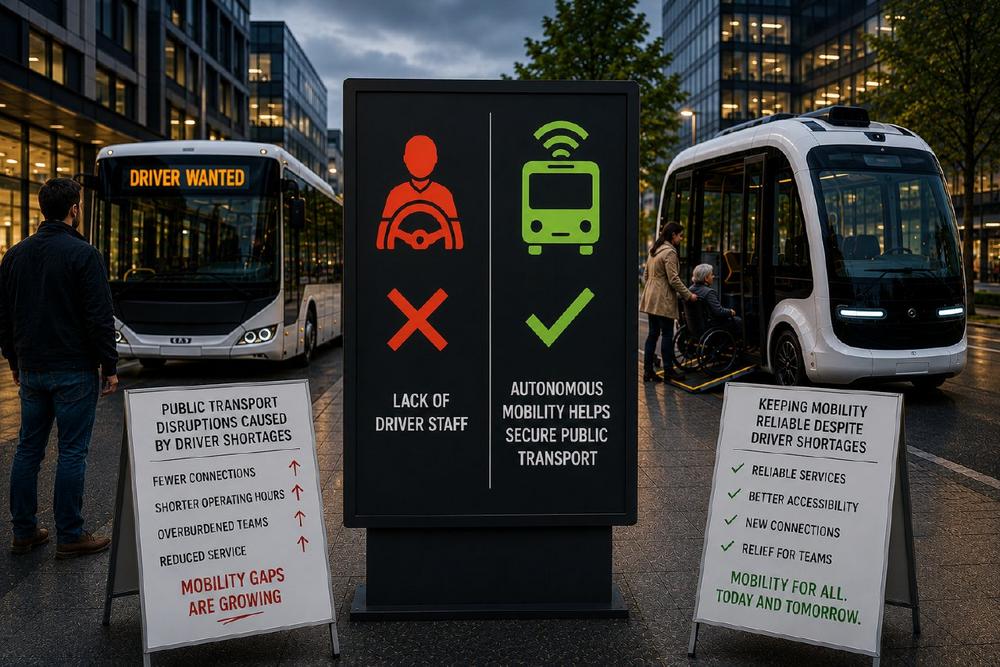
The discussion about autonomous mobility often centers on technological issues: sensors, AI, levels of automation, and approval processes take center stage. For the future of public transportation, however, another factor is likely to become at least as crucial: the growing shortage of qualified drivers.
What was long considered an operational staffing problem for individual transit companies is increasingly becoming a structural challenge for the entire mobility sector. Canceled shifts, reduced schedules, or service expansions that cannot be implemented are already a reality in many places. This brings a fundamental question to the forefront: How can public mobility be operated stably in the long term if staffing resources are not growing at the same rate as mobility demand? This also shifts the nature of the challenge itself. It is not the maximum automation of individual vehicles that will determine the future of autonomous mobility, but rather the ability to effectively supplement scarce personnel resources with new operational architectures. Autonomous mobility thus becomes a question of the scalability of operations, responsibility, and control.
The German federal government explicitly describes the shortage of professional drivers as one of the central challenges for the future of mobility in Germany. At the same time, autonomous driving is seen as a building block for creating new mobility services and closing existing gaps in service coverage.
Autonomous mobility requires new operational models
This also changes the strategic role of autonomous mobility. It is not primarily a technology for automating individual vehicles, but rather a tool for further developing the entire operational model. In public transportation in particular, several goals must be achieved simultaneously: route offerings should remain stable, service hours should be extended, new connections should be created, and at the same time, cost-effectiveness and availability should be improved. Given the growing shortage of skilled workers, these requirements can only be met to a limited extent in many places using traditional operating models.
The handbook *Autonomous Driving in Public Transportation* therefore explicitly addresses staffing and financing issues as an integral part of future operational planning. Staff availability is thus not viewed as a peripheral consideration, but as an integral part of the system design.
System integration reduces the burden
Autonomous mobility should therefore not be viewed exclusively from the perspective of efficiency. Its true added value lies in its ability to help sustain mobility services over the long term despite limited staffing resources. The key factor here is not the replacement of individual driver positions. Rather, it is the ability to ensure that mobility remains available over the long term despite limited staffing resources.
Autonomous vehicles do not simply replace drivers. Rather, new operational architectures are emerging in which control centers, technical supervision, teleoperation, fleet management, and service personnel together form an integrated mobility system. The role of humans is changing—it is not disappearing. This also shifts the technical perspective. What matters is not merely whether a vehicle can drive autonomously. What matters is whether autonomous vehicles can be integrated safely, reliably, and cost-effectively into existing operational processes and remain available there on a long-term basis.
International strategies confirm the trend
An international comparison shows that this development is by no means limited to Germany. Singapore’s Ministry of Transport articulates the connection between autonomous driving and the shortage of skilled workers with unusual clarity. A parliamentary statement reads: “AVs will add to our public transport network without running up against fundamental manpower constraints.”
There, autonomous vehicles are explicitly viewed as an opportunity to expand public transportation services without being hindered by fundamental staffing shortages. The driver shortage is thus not regarded as a short-term operational problem, but rather as a strategic starting point for future mobility planning.
Vehicle Control Becomes an Operational Factor
This is precisely where the technical challenge shifts. If autonomous vehicles are to take on tasks within critical mobility services in the future, they must be able to do more than just drive automatically. They must be permanently controllable, available, and safely integrated into operational processes. Vehicle control thus becomes a prerequisite for new operational architectures. This is because control centers, technical oversight, and fleet management can only scale if vehicle movement can be controlled in a reproducible manner at all times. With NX NextMotion, Arnold NextG addresses precisely this challenge. The fail-operational drive-by-wire platform treats vehicle control as a standalone system level and lays the foundation for controllable vehicle movement, teleoperation, and software-defined vehicle architectures.
Conclusion
The growing driver shortage is fundamentally changing the discussion about autonomous mobility. The focus is no longer exclusively on the automation of individual vehicles, but rather on the future viability of public mobility systems. The driver shortage does not make autonomous mobility more important simply because fewer drivers are available. It makes it clear that public mobility must be organized differently in the future. The real challenge, therefore, is not to replace drivers, but to keep public mobility operational in the long term under new conditions. To achieve this, control, responsibility, and operations must be reimagined together.
We Control What Moves
For more information, visit: www.arnoldnextg.com/Blog
Arnold NextG realizes the safety-by-wire® technology of tomorrow: The multi-redundant central control unit NX NextMotion enables a fail-safe and individual implementation, independent of the vehicle platform and unique worldwide. The system can be used to safely implement autonomous vehicle concepts in accordance with the latest hardware, software and safety standards, as well as remote control, teleoperation or platooning solutions. As an independent pre-developer, incubator and system supplier, Arnold NextG takes care of planning and implementation – from vision to road approval. With the road approval of NX NextMotion, we are setting the global drive-by-wire standard. www.arnoldnextg.com
Arnold NextG GmbH
Breite 3
72539 Pfronstetten-Aichelau
Telefon: +49 171 5340377
http://www.arnoldnextg.de
