ITC 1996: When Opel and Manuel Reuter Became Motorsport Icons

Breaking News:
Donnerstag, Okt. 1, 2026
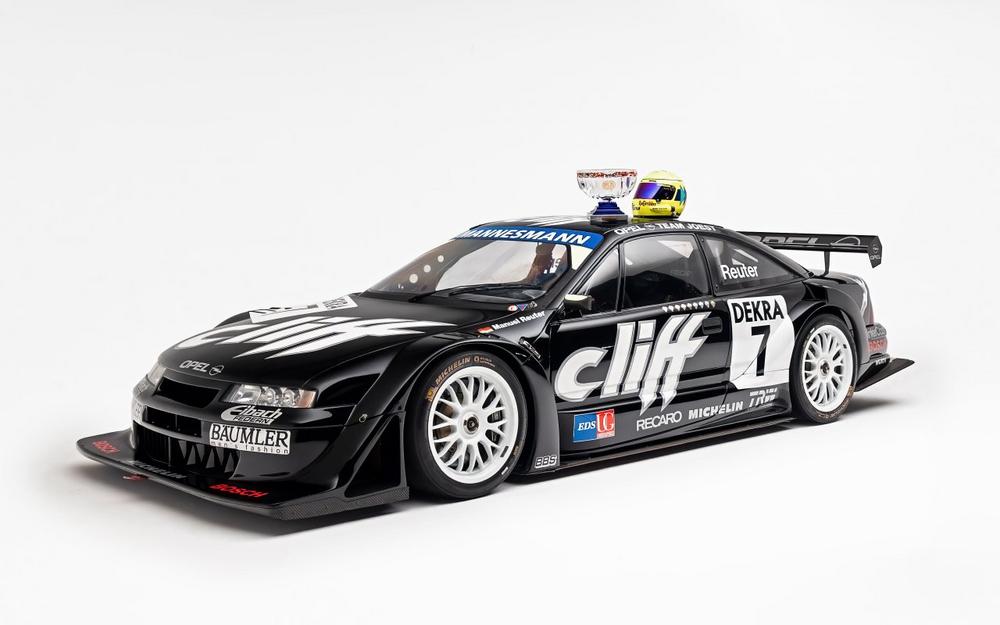
not a day like any other for Opel. On that Sunday 30 years ago, the Rüsselsheim-based car manufacturer celebrates Manuel Reuter’s victory in the International Touring Car Championship (ITC) in Brazil in the Opel Calibra V6 4×4. Together with Walter Röhrl’s 1982 World Rally Championship title, it is the greatest success in Opel’s motorsport history, which began as early as 1899. Reuter, his black Calibra and Opel secure their place as icons of international motorsport with their triumph in the unofficial World Touring Car Championship.
At the time, the ITC with its Class 1 cars was the most technically developed racing series in the world – even compared to Formula 1. The battle between the all-wheel-drive race cars from Opel and Alfa Romeo against the rear-wheel drive Mercedes produced increasingly elaborate results. The V6 engines, limited to 12,000 rpm, produced around 520 hp, and the all-wheel-drive vehicles had electronically controlled differentials. Mercedes countered with hydraulically adjustable weights on the underbody, with which they could influence traction when accelerating out of corners. Racing ABS, variable blinds on the front wings, stabilisers that could be adjusted at full speed and semi-automatic transmissions, which were just as sensitive as the high-revving engines, were all standard. Therefore, the engineers developed modular systems in which, in the event of engine or transmission damage, the entire front end was replaced instead of the individual component. Quick-release fasteners opened, wiring harness unplugged, hoses down, complete module gone, new front end on, plug everything back in – if necessary, this worked in less than three minutes.
The battle between Alfa Romeo, Mercedes-Benz and Opel was also unbeatable in sporting terms. 26 ranked races in 13 events on three continents were on the programme. The ITC, which emerged from the DTM, made guest appearances in Germany, England, Italy, Portugal, Finland, France, Brazil and Japan. At the wheel of the 520 hp cars were world-class drivers such as Nicola Larini, Alessandro Nannini, Giancarlo Fisichella, Christian Danner, Bernd Schneider, Dario Franchitti, Jan Magnussen, Kurt Thiim, Klaus Ludwig, Hans-Joachim Stuck, J.J. Lehto – and the ultimately victorious Opel driver Manuel Reuter.
Changing leads: Pure excitement in the second half of the season
The course of the season was turbulent. Opel star Reuter took the lead in the standings with two victories in the first two events at Hockenheim and at the Nürburgring and held it until September, when he was hit by a small streak of bad luck. After a collision at the Nürburgring and an engine failure at Magny-Cours, in which marshals failed to extinguish a fire which resulted in the Calibra burning out, Nannini made up 70 points in four races. Schneider then took the lead in the standings after the two races in Mugello.
But at the European finale of the ITC, the tide turned again. Like Nannini in Mugello, Schneider scored a zero in Hockenheim, while Reuter scored 35 points. His celebrations are remembered to this day. He stopped the Cliff Calibra in the middle of the start and finish straight after his victory in the second race, got out and was celebrated by the tens of thousands of Opel fans in the sold-out Motodrom. Something that earned him a hefty fine of 10,000 dollars from the FIA. "It was worth it," the Mainz-born driver still grins today.
With the strong performance at the home race, Reuter had given himself a little breathing space in the championship. The final overseas races in São Paulo/Brazil and Suzuka/Japan would decide the ITC title in 1996.
Excitement even before departure: Chaos on the journey to Brazil
For Opel and especially Manuel Reuter, the hot days before and during the penultimate race weekend of the ITC were extremely stressful: The black Cliff-Calibra had already fallen off a pallet during loading at Frankfurt Airport. However, the damage was limited with two broken and two bent shock absorbers. But in retrospect, this incident was the prelude to a spectacular, curious and sometimes dicey race weekend in São Paulo.
The metropolis of ten million people proved to be a hot spot for the ITC entourage. On the approximately 45-kilometre journey from the Aeroporto Internacional de São Paulo/Guarulhos to the Autódromo José Carlos Pace on the outskirts of Interlagos, the convoy of ITC transporters came under fire from a sniper at a red light in broad daylight. The local truck drivers, however, did not hesitate and returned fire. Because the police were also on the scene quickly – a routine operation for the Brazilian law enforcement officers – the attacker quickly fled, so that there were isolated bullet holes and two flat tires in the trucks. Additionally, in the previous week, local hero Tony Kanaan, who replaced the Austrian Alexander Wurz as an Opel guest driver in São Paulo, was robbed on the street in his hometown – twice!
Turbulent rain race in São Paulo: Magnificent catch-up race to the title
The race weekend did not go one hundred percent smoothly for Opel either, especially for title contender Manuel Reuter. Problems with the set-up of the Calibra and an accident in free practice on Friday had given the championship leader a mediocre twelfth place on the grid. Reuter duelled with opponent Bernd Schneider on a damp track until the finish in the first race, but was able to outpace the Mercedes and crossed the finish line in fourth place. Reuter thought he was on course.
But only a few minutes later, the championship decision seemed to be postponed to the season finale in Suzuka: After the end of the 20-minute repair break between the two races, the starter of the Cliff-Calibra refused to work, so that Reuter had to start the second heat from the pit lane. The rain had increased in the meantime – which would ultimately play into the hands of the Opel driver. For when the ‘Opel spies’ noticed that Schneider, hoping for an improvement in the weather, had his racing car fitted with slicks whilst still on the starting grid, the Rüsselsheim team decided to have the Cliff-Calibra fitted with slick tyres as well. “We were leading the championship, so we wanted to do the same as Bernd to be on the safe side,” recalls Manuel Reuter.
While Schneider initially suffered from a lack of grip due to his fateful tyre choice and only got going in the second half of the race on a drying track, Reuter calmly made up position after position with his all-wheel drive car and finished fourth place again. "At the beginning it was quite dangerous, I had to go through the gravel twice," said the Opel works driver. "But in the course of the race, our tyre choice proved to be the right one." It took a few moments for Manuel Reuter to realise what he had just done: "When my team pushed the word ‚Champ‘ to the cockpit display when I crossed the finish line, I first asked if they were sure and hadn’t miscalculated. I couldn’t believe that we had won the last ITC title in history on this weekend full of ups and downs."
Motorsport history: 1996 as a golden year for Manuel Reuter and Opel
It was the reward for years of hard work in a technically extremely demanding environment. "Our biggest problem was consistency," recalls Reuter. "Over the course of the 1995 season, we realised that we had too much complex technology in the car. The good results came with the retrofitting of the Calibra." In Magny-Cours, Reuter was second, Ludwig celebrated a double victory in Hockenheim. For 1996, the Calibra received a new, powerful engine. The new semi-automatic transmission from Williams was only integrated when it worked perfectly. Opel was well-prepared for 1996.
Reuter recalls: "We were able to build up a good cushion in the first half of the season. Then it became more difficult. From the third race weekend in Estoril, I almost always had maximum placement weight in the car and still often finished in the top five. Schneider in the Mercedes and Nannini in the Alfa had a harder time. While the other manufacturers relied on one or two drivers as spearheads early on, Opel could drive freely. So I had to prevail against seven strong teammates. On the other hand, we also motivated each other."
1996 was a highlight in the great career of Manuel Reuter, who in addition to the ITC title also celebrated his second overall victory at the 24 Hours of Le Mans. "The ITC would have deserved to continue to exist," says the Opel star, not without melancholy. "The Class 1 period was a special era for everyone who experienced it – both for us drivers and for the technicians and the fans. It was an unforgettable time that I was able to experience with Opel back then. And 1996 was really a golden year!"
Opel Automobile GmbH
Bahnhofsplatz 1
65423 Rüsselsheim
Telefon: +49 (6142) 7-70
Telefax: +49 (6142) 77-8409
http://de-media.opel.com/de
