
BLE tracking in logistics: Who is the technology suitable for?
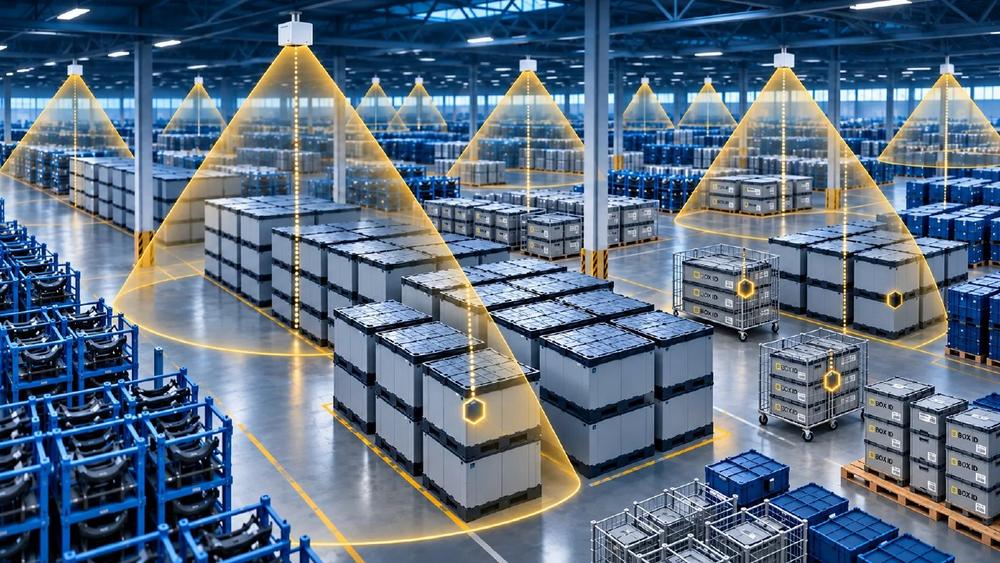
Anyone considering BLE tracking in logistics should therefore first take a look at their logistics cycles. Where do the cargo carriers move? How many are traveling together? Do they stay together, or do they go their separate ways after delivery?
And what information is needed to reliably manage inventory and returns? These are questions many industries are asking. Containers in industrial manufacturing, roll containers in retail, transport racks in the construction supply chain, and reusable packaging in distribution networks all follow different processes. Whether a BLE-based approach is suitable can be better determined by these processes than by the industry label alone.
Many load carriers share the same infrastructure
In BLE-based tracking, each equipped cargo unit carries a small, energy-efficient BLE beacon. This beacon transmits signals that are received by gateways in its environment and forwarded to the software platform. Stationary gateways track containers in factories, warehouses, or depots, for example. Mobile gateways travel along with selected cargo units and track other units in their environment.
As a result, many load carriers can share a common infrastructure for data transmission. This makes the hybrid approach particularly attractive for large fleets: There is no need for a separate cellular connection on each individual container.
The hybrid approach is particularly attractive when many load carriers are regularly on the road together or reliably pass by collection points.
Not all locations need to belong to the company itself. Suppliers, customers, or logistics partners can also be part of the tracking system. The key factor is whether the load carriers encounter a stationary or mobile gateway there with the required frequency.
Which cycles provide ideal conditions
Example: A company supplies its production sites from a central warehouse. Reusable containers are delivered, emptied, and returned in large groups. Fixed tracking points can be set up at the most important locations. From a logistics perspective, the most important factors are which stocks are available, how long the containers remain at the sites, and how quickly they rotate.
A similar pattern can be found in retail: roll containers move between distribution centers and stores, accumulate at recurring points, and begin their return journey from there. Industrial suppliers, pool operators, or companies with regular depot traffic may also have such structures.
These are ideal conditions for BLE tracking in logistics. Tracking can be organized to follow actual movements. Stationary gateways cover key areas, while mobile gateways supplement visibility across the network. As the number of devices increases, a broader database is created for stocks, dwell times, and circulation rates. However, a formally closed loop alone is not yet sufficient. Two locations may have regular traffic between them, while individual load carriers may be removed en route, taken in for repair, or transferred to third parties. Such detours must be factored into the analysis.
The group must also make it back safely
On the way to the recipient, things seem simple: A truck is transporting a large group of load carriers, some of which are equipped with mobile gateways. As long as the units stay together and remain within radio range, the BLE beacons can be detected collectively.
This situation may change after delivery. Some containers are emptied immediately and returned. Others remain with the recipient for several weeks. A few are transferred to an off-site warehouse or delivered to another location. By that time, the mobile gateway may have long since been back on the road.
Therefore, when assessing the suitability of BLE tracking in logistics, it is important to consider how groups change throughout the entire circulation process. A jointly conducted transport does not guarantee that the items will be tracked together during the subsequent downtime. This also applies within a single location. Load carriers on the same premises may be located far apart or shielded from one another by buildings and materials. The planned tracking must be adapted to these conditions.
When individual load carriers are widely scattered
Other applications are more decentralized from the outset. A transport rack is located at a single customer’s site. A container remains with a small supplier. Reusable packaging ends up at various construction sites, off-site warehouses, or storage areas whose exact locations no one knows in advance. Sometimes they are literally scattered across fields, forests, and meadows.
In that situation, regular gateway connections cannot be expected. Although a BLE beacon continues to transmit its signals, no new information is sent to the system unless a suitable receiver is within range.
A BLE beacon becomes visible wherever it is detected. For scattered individual assets, this visibility is the key issue.
If such a cargo carrier needs to report its location independently even far from known tracking points, a cellular tracker may be a better fit. It does not require a local BLE gateway, but it does depend on adequate cellular coverage and the relevant location conditions.
This distinction also applies to the purpose of tracking. Someone who primarily wants to monitor inventory at specific locations has different requirements than someone who needs to locate individual load carriers that have been set aside outside the planned cycle.
How up-to-date does the information need to be?
For inventory planning, regular counts at designated locations may be sufficient. Dwell times and circulation rates can also be derived from appropriate counting events. A complete location history is often not necessary for this purpose.
The situation is different when the dispatch department needs to know where a specific load carrier is located at short notice. In that case, what matters is when and where the last update took place and whether that information still reflects the current situation.
Data from the previous day can be helpful when analyzing a circulation cycle spanning several weeks. However, it may be too old for an urgent pickup. The required data freshness should therefore be determined before making a technology decision. It influences where gateways are needed, how frequently data must be collected, and which units require a standalone connection.
The number of assets determines the economic calculation based on
For large fleets, the benefits of shared infrastructure can be significant. When additional load carriers are included within an existing coverage area, the costs of setting them up and operating them are spread across more units. This makes it easier to economically equip a larger portion of the fleet.
However, a large number of units alone does not guarantee this effect. Placing 50,000 containers at a few easily accessible hubs presents different challenges than distributing 50,000 containers individually across an equal number of varying locations. Likewise, BLE can also be useful for a smaller fleet if the necessary infrastructure is already in place or can be set up with minimal effort.
Cost-effectiveness results from the interplay of fleet size, distribution, and the level of tracking required. The price of the beacon is only one part of it.
The overall cost also includes gateways, installation, operation, and the question of whether the data collected delivers the desired benefits. Inexpensive hardware is of little help if, of all things, the relevant stock is not reliably tracked. A properly designed solution, on the other hand, can not only lower tracking costs but also reduce the time spent searching for items and improve the utilization of the existing fleet.
Individual circulations may require individual technologies
Many companies have both: large, regularly circulating inventories and individual load carriers with routes that are difficult to predict. A single solution can account for these differences.
BLE-based systems handle tracking where load carriers operate in a network or regularly reach designated tracking points. Autonomous trackers supplement visibility for widely dispersed units or routes with special requirements. In the BOX ID system, this information is consolidated into a unified view of the fleet.
For an assessment, BOX ID begins with actual usage: How many assets are there, among which parties do they circulate, and where do groups disband? Which locations are known and accessible, and which ones change? How far back in time can information go and still be useful for inventory planning, return, and search?
The answers make it possible to assess where BLE tracking can demonstrate its advantages in logistics and where it makes sense to use it as a complementary solution. This results in a tracking architecture that fits the supply chain – whether in in-plant transportation, retail, supplier networks, or when supplying locations that change frequently.
BOX ID Systems GmbH
Lichtenbergstraße 8
85748 Garching bei München
Telefon: +49 (89) 2190973-60
http://www.box-id.com
