
Teleoperation with Drive-by-Wire: Why Remote Control Requires a Closed-Loop Vehicle Control System
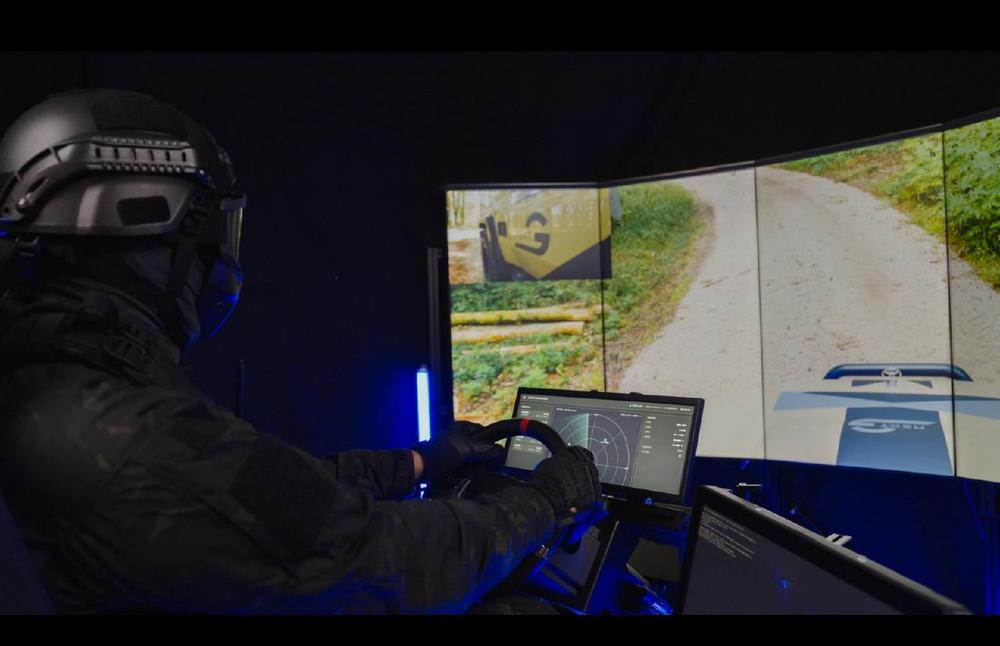
For developers, OEMs, Tier 1 suppliers, and system integrators, teleoperation thus becomes a matter of vehicle and control architecture. A communication link can transmit control commands. However, it guarantees neither their controlled implementation in the steering, brakes, and drivetrain nor reliable feedback on how the actual vehicle is responding.
Teleoperation is more than just a communication link
A teleoperated platform requires a continuous control path from the external operator station to the vehicle’s motion functions—and a return channel back to the operator. This creates a closed-loop control system:
Control command → electronic processing → actuators → vehicle movement → feedback to the operator.
The civil regulatory framework also demonstrates how important this holistic system approach is. The German Road Traffic Remote Control Ordinance explicitly considers the vehicle and technical remote control equipment as a single system and requires that transmission latencies be taken into account in the safety concept. For certain signals that directly assist the operator during dynamic driving tasks, the regulation stipulates a maximum signal latency of 0.2 seconds. This is not a defense requirement, but it illustrates the close technical coupling between communication, processing, and vehicle response.
For defense applications, the specific interpretation remains dependent on the respective operational and system context. The fundamental engineering question, however, remains the same: How does an externally transmitted command translate into controlled vehicle movement?
Drive-by-Wire bridges the gap between the control center and vehicle movement
This is exactly where drive-by-wire comes into play. Steering, braking, and propulsion become electronically controllable and can be integrated into a higher-level digital control architecture. With NX NextMotion, Arnold NextG provides a safety-critical control layer for this purpose. External control commands are processed, checked for plausibility, and translated into actual vehicle motion via the respective actuators. At the same time, the architecture monitors the involved functions and can respond to detected errors with defined actions.
Teleoperation is thus not a separate remote control system operating alongside the actual vehicle control system. It becomes a control source within the motion architecture. The technical design of NX NextMotion and the integration of different control sources are also documented in the ATZ Heavy-Duty technical article on the drive-by-wire platform.
The feedback channel plays a key role in determining the quality of teleoperation
The farther the operator is from the vehicle, the more important it becomes to determine what information is fed back from the real-world platform. Camera images constitute part of this feedback. Depending on the system design, this is supplemented by status data as well as information on vehicle response, steering forces, slip, or road surface conditions. This information can be provided via visual, digital, or haptic feedback channels. The importance of feedback becomes particularly evident with force feedback.
In NX NextMotion, haptic feedback is an integral part of the safety-critical steering path. In the underlying safety concept, it is treated as safety-critical based on fault tree analysis. The haptic feedback signal is not generated solely within the operator interface. NX NextMotion derives it from plausibility-checked physical and vehicle-dynamics variables. This transforms force feedback from a mere operating feature into a component of the closed-loop motion control system.
Real-time, redundancy, and error response requirements apply to this processing just as they do to the rest of the steer-by-wire function. The control and diagnostic cycle of NX NextMotion is two milliseconds. The underlying technical approach is documented in the ATZ Heavy-Duty technical paper.
The safety architecture changes without a driver
In a manned platform, a driver can serve as a fallback option under certain conditions. In an unmanned or fully teleoperated vehicle, this assumption no longer applies. Communication, sensors, actuators, control, and power supply must therefore be considered as a coherent, safety-oriented control path. A communication failure or the loss of a signal path must not lead to uncontrolled vehicle movement.
For drive-by-wire systems, this means that the architecture must detect faults, evaluate the remaining functional capabilities, and enable a defined response. NX NextMotion is designed to be multi-redundant and fail-operational for this purpose. What is crucial here is not merely the redundancy of a single control unit, but rather the consideration of the entire safety-relevant chain of effects. Arnold NextG also describes this architectural approach—in the context of controlled driverless vehicle movement—as a permanent fallback level. Background: Fail-operational drive-by-wire in NX NextMotion (https://www.pressebox.de/…)
Teleoperation is becoming an integrated vehicle function
For defense platforms, the technical challenge lies not solely in the transmission of control commands. The key is how external operation, vehicle control, and actuators are integrated into a unified architecture. The remote operator, the communication link, and the drive-by-wire control layer each perform different tasks. While the operator station generates control commands and visualizes vehicle information, NX NextMotion links these commands to the vehicle’s actual motion functions.
This keeps the system levels clearly separated: teleoperation provides the control source, while drive-by-wire handles the controlled implementation in the steering, brakes, and powertrain.
This separation is particularly relevant for OEMs, Tier 1 suppliers, and system integrators. New control or automation functions can be integrated into the vehicle architecture via defined interfaces, while the connection to actuators, the vehicle electrical system, and communication systems remains platform-specific.
What OEMs and Integrators Need to Consider in Defense Teleoperation
Therefore, when technically evaluating a teleoperated platform, it is not only the range or bandwidth of the communication link that is relevant. The following factors are particularly crucial:
This shifts the central development question from “How do we transmit a driving command?” to “How do we achieve a closed-loop, controllable vehicle control system?”
Teleoperation becomes a system feature of the platform
Particularly in the defense sector, teleoperation can apply to various platform types and usage concepts—from newly developed unmanned vehicles to digitized legacy platforms. For scalable integration, it is therefore crucial not to treat teleoperation as an isolated add-on function. External control must become an integral part of a vehicle architecture that considers electronic control, feedback, diagnostics, and error response as a unified whole.
NX NextMotion forms the drive-by-wire control layer between external control commands and actual vehicle movement. Put simply, the technological core is this: Teleoperation does not merely transfer control over a distance. It must also maintain control over movement across that distance.
WE CONTROL WHAT MOVES
more infirmation: www.arnoldnextg.com
Sources and Technical Classification
Road Traffic Remote Control Ordinance (StVFernLV), Annex 1 – Technical Requirements
Regulatory Framework for Remote Control in Civil Road Traffic; used in this article exclusively for the technical classification of signal latency, not as a defense requirement.
https://www.gesetze-im-internet.de/stvfernlv/anlage_1.html
ATZheavy duty 02/2026 – “Drive-by-Wire Platform for the Integration of Various Control Sources”
Technical foundation for, among other things, NX NextMotion, teleoperation, force feedback, and the control and diagnostic cycle.
https://link.springer.com/article/10.1007/s35746-026-1416-1
Über Arnold NextG:
Arnold NextG realisiert die Safety-by-Wire®-Technologie von morgen: das mehrfach redundante Zentralsteuergerät NX NextMotion ermöglicht eine ausfallsichere und individuelle Implementierung, fahrzeugplattform-unabhängig und weltweit einzigartig. Mit dem System können autonome Fahrzeugkonzepte sicher und nach den neuesten Hard- und Software- sowie Sicherheitsstandards umgesetzt werden, ebenso wie Remote-, Teleoperation- oder Platooning- Lösungen Als unabhängiger Vorausentwickler, Inkubator und Systemlieferant übernimmt Arnold NextG die Planung und Umsetzung – von der Vision bis zur Straßenzulassung. Mit der Straßenzulassung von NX NextMotion setzen wir den globalen Drive-by-Wire-Standard. www.arnoldnextg.de
About Arnold NextG:
Arnold NextG realizes the safety-by-wire® technology of tomorrow: The multi-redundant central control unit NX NextMotion enables a fail-operational and individual implementation, independent of the vehicle platform and unique worldwide. The system can be used to safely implement autonomous vehicle concepts in accordance with the latest hardware, software and safety standards, as well as remote control, teleoperation or platooning solutions. As an independent pre-developer, incubator and system supplier, Arnold NextG takes care of planning and implementation – from vision to road approval. With the road approval of NX NextMotion, we are setting the global drive-by-wire standard. www.arnoldnextg.com
Arnold NextG GmbH
Breite 3
72539 Pfronstetten-Aichelau
Telefon: +49 171 5340377
http://www.arnoldnextg.de
